On Saturday, Israel’s president appointed Gadi Eisenkot, the most formidable opponent of Prime Minister Benjamin Netanyahu, to attempt to establish a new government after an election that resulted in a stalemate, leaving both figures without a straightforward route to leadership.
Netanyahu, who has been in power longer than any other leader in Israel’s history, is striving to retain his position following his religious-nationalist coalition’s loss of majority status in the election held on October 27, although his party remains the largest in parliament.
An anti-Netanyahu coalition led by Eisenkot, a former military chief, has declined to collaborate with Arab parties, which could potentially provide them with a majority in the Knesset, Israel’s parliament.
Despite this, Arab leaders, outraged by what they perceive as the discriminatory policies of Netanyahu and his far-right partners, have still backed Eisenkot to take the initial steps toward government formation, granting him the highest number of endorsements.
“President Herzog has invited Gadi Eisenkot to the President’s Residence, where he will be assigned the task of forming the government tomorrow,” stated a spokesperson for President Isaac Herzog, who, though operating in a largely ceremonial capacity, plays a role in nominating candidates to create a coalition post-elections.
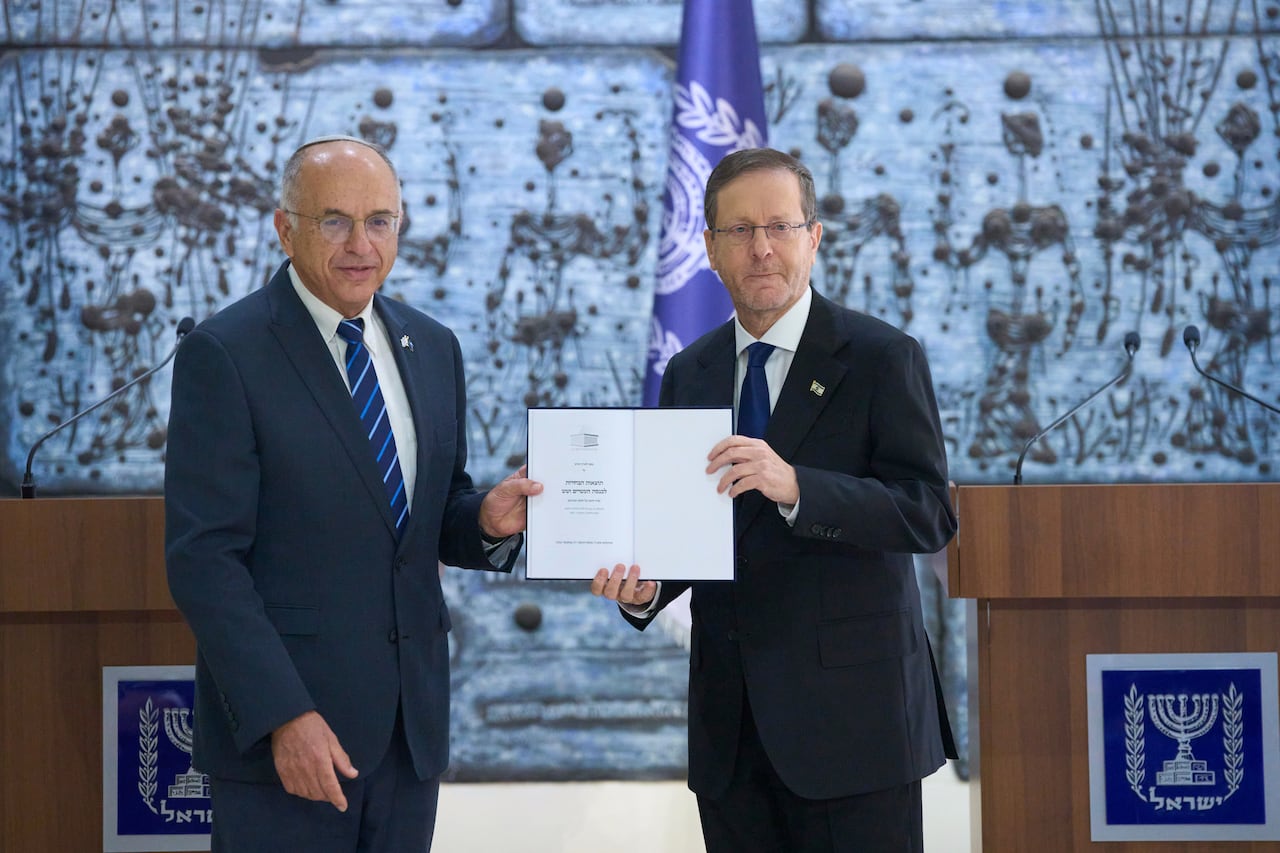
Israel’s President Isaac Herzog, right, receives the results of Israel’s elections from Supreme Court Justice Noam Sohlberg at the president’s residence in Jerusalem on Wednesday. (Ohad Zwigenberg/The Associated Press)
Following Eisenkot’s nomination, a prolonged period of negotiations is anticipated. He has a time frame of 28 days to form a government, with the possibility of a 14-day extension.
Eisenkot’s potential strategies for gaining power involve seeking to establish a minority government with external support from Arab parties, forming a coalition with ultra-Orthodox parties that he and his allies have previously avoided, or creating a unity government in partnership with Netanyahu.
Experts suggest that the viability of all three options is questionable. Should Eisenkot not succeed, another individual may attempt to establish a government, and should that individual also fail, parliament has the authority to nominate yet another candidate.
The entire process is subject to a deadline of approximately 100 days. If no candidate is successful, a new election will be called.
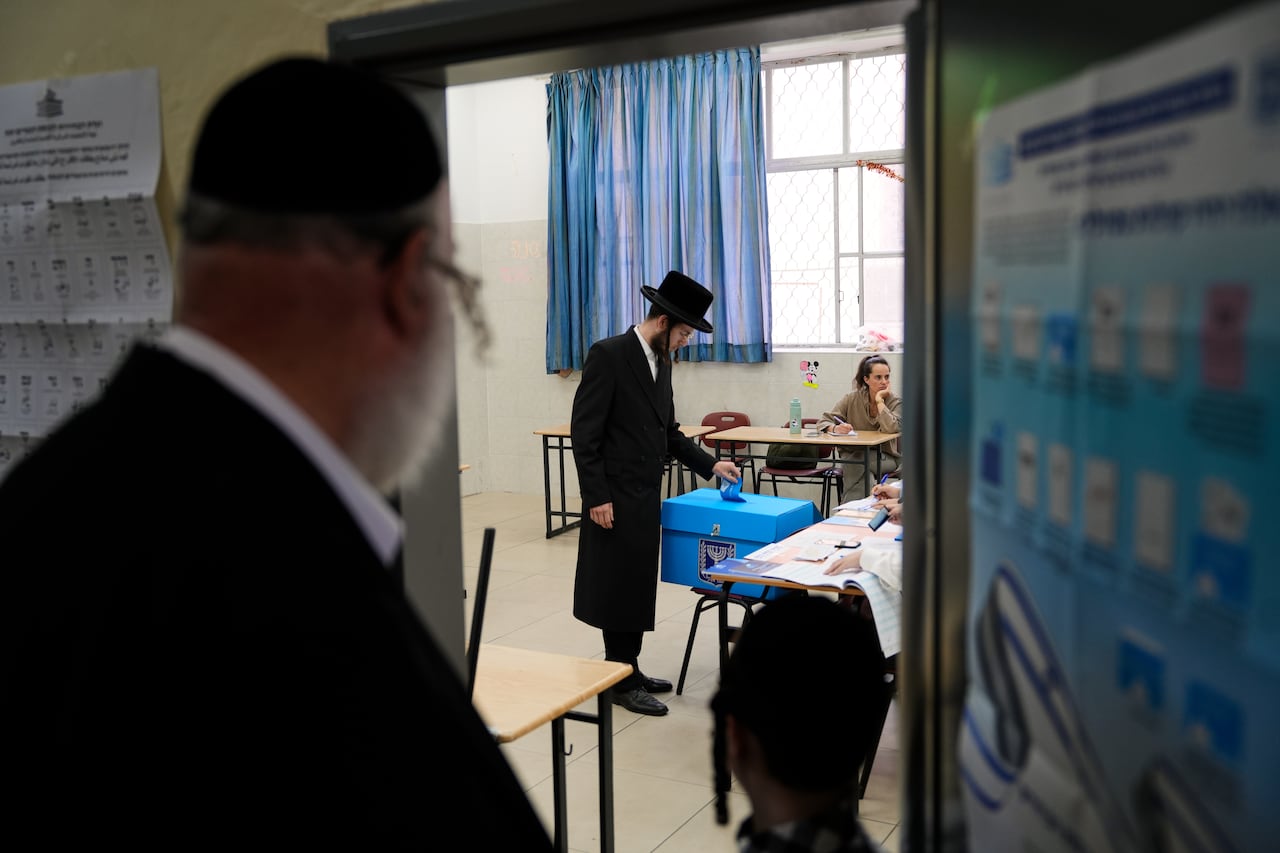
An Orthodox Jewish voter casts a ballot at a polling station in Haifa, Israel, on Oct. 27. (Baz Ratner/The Associated Press)
“This is the moment to create a national emergency government. I am committed to doing everything within my power to prove our worth,” Eisenkot shared on his X account shortly after the president’s announcement.
The Likud party secured the highest number of seats, claiming 27 in the 120-seat Knesset, while Netanyahu’s broader religious-nationalist coalition only totaled 53 seats, falling short of the 61 needed for a majority.
Eisenkot’s Yashar party emerged as the second-largest faction with 21 seats, whereas his coalition, which encompasses four parties ranging from center-left to right-wing, obtained a total of 48 seats. Meanwhile, two parties representing Israel’s Arab minority achieved a historic total of 19 seats.
Political newcomer
Eisenkot, 66, who is the son of Moroccan immigrants, would become the first prime minister from Israel’s Mizrahi community, comprised of Jews with ancestral ties to the Middle East and North Africa.
Eisenkot, who is typically reserved and avoids the media, only entered the political arena in 2022. He briefly participated in Netanyahu’s wartime cabinet following the Hamas attack on Israel on October 7, 2023, before returning to the opposition.
In his role as an opposition leader, he publicly criticized Netanyahu’s leadership, particularly regarding the handling of the military operation in Gaza, pledging that he would refuse to serve in a government alongside him.
Eisenkot’s reputation is also intertwined with the personal sacrifices made by his family since 2023: he lost a son and two nephews in the conflict in Gaza.
During his campaign, Eisenkot emphasized his security expertise, referencing his “Dahiyeh doctrine,” which advocates for responding to attacks with overwhelming force, a strategy he applied as a commander during Israel’s 2006 conflict with Hezbollah in Lebanon.
Eisenkot has condemned the rise in settler violence against Palestinians, which has escalated since 2023, heightening strains in Israel’s relationships with Western nations. He stands in opposition to Netanyahu’s far-right coalition partners, Itamar Ben-Gvir and Bezalel Smotrich, both of whom have faced repercussions from certain Western countries for inciting violence against Palestinians.
