
Foreign Affairs Minister Anita Anand confirmed on Friday that out of nearly 2,000 individuals reported missing following the devastating flash flood near the Nepal-Tibet border, 32 are Canadian citizens or permanent residents.
During a press conference, Anand stated that 579 bodies have been retrieved from the affected region, while 1,924 individuals remain unaccounted for, including 517 foreigners.
Moreover, Anand noted that no Canadians have been confirmed deceased.
“Nepal is confronting a severe humanitarian crisis with extensive destruction,” she remarked.
Canada has also pledged $5 million in aid to assist with emergency relief efforts in Nepal.
As rescuers navigated through mud and debris on Friday, they continued their search for those who remain missing in the flood-ravaged areas.
Authorities from both Nepal and China cautioned about the risk of additional flooding from a lake that has formed upstream due to Wednesday’s events, which is already at risk of overflowing. Residents in vulnerable areas were advised to seek higher ground.
According to Nepal’s National Disaster Risk Reduction and Management Authority, 3,742 individuals have been rescued.
Among the missing are tourists from various countries. Brig.-Gen. Raja Ram Basnet, a spokesperson for the Nepalese army, informed The Associated Press that a team was dispatched on Friday to the Upper Trishuli-1 Hydropower Project near the Nepal-China border following reports of individuals trapped in a tunnel.
“Locating the entry and exit points of the tunnel is complicated as everything is covered in mud,” Basnet explained. “Our top priority is to rescue those trapped.”
The rescue operations have proven to be difficult, with access to some of the hardest-hit communities being limited, as noted by Santosh Pandey, Oxfam’s humanitarian lead in Nepal, during an interview with CBC’s As it Happens from Kathmandu.
“Entire villages and communities have been completely swept away. There is no one left to assist each other,” Pandey remarked.
“A significant amount of public infrastructure has been damaged, with many hospitals and health facilities completely destroyed.”
“The situation is extremely chaotic at present.”

Emergency responders rescued 350 individuals trapped inside a tunnel, as shown in a video released by Nepal’s Prime Minister’s Office on Friday. Efforts are ongoing to assist over 100 individuals still trapped following Wednesday’s flash flooding that obliterated villages and infrastructure in Nepal.
‘We have to find him’
As the rescue teams strive to locate remaining survivors, anxious families have gathered outside hospitals hoping to identify their missing loved ones among the hundreds of recovered bodies.
At the Tribhuvan University Teaching Hospital, relatives are seen scrutinizing somber photographs displayed on a wall outside the forensic identification unit.
The images depict the severely damaged bodies of victims, including young children who were recovered from the mud.
“I came here in hopes of finding [my brother]. I will search until my last breath,” stated Nirmala Sapkota Koholi, 49, a resident of Lalitpur, south of Kathmandu.
“I must go everywhere; we have to find him.”
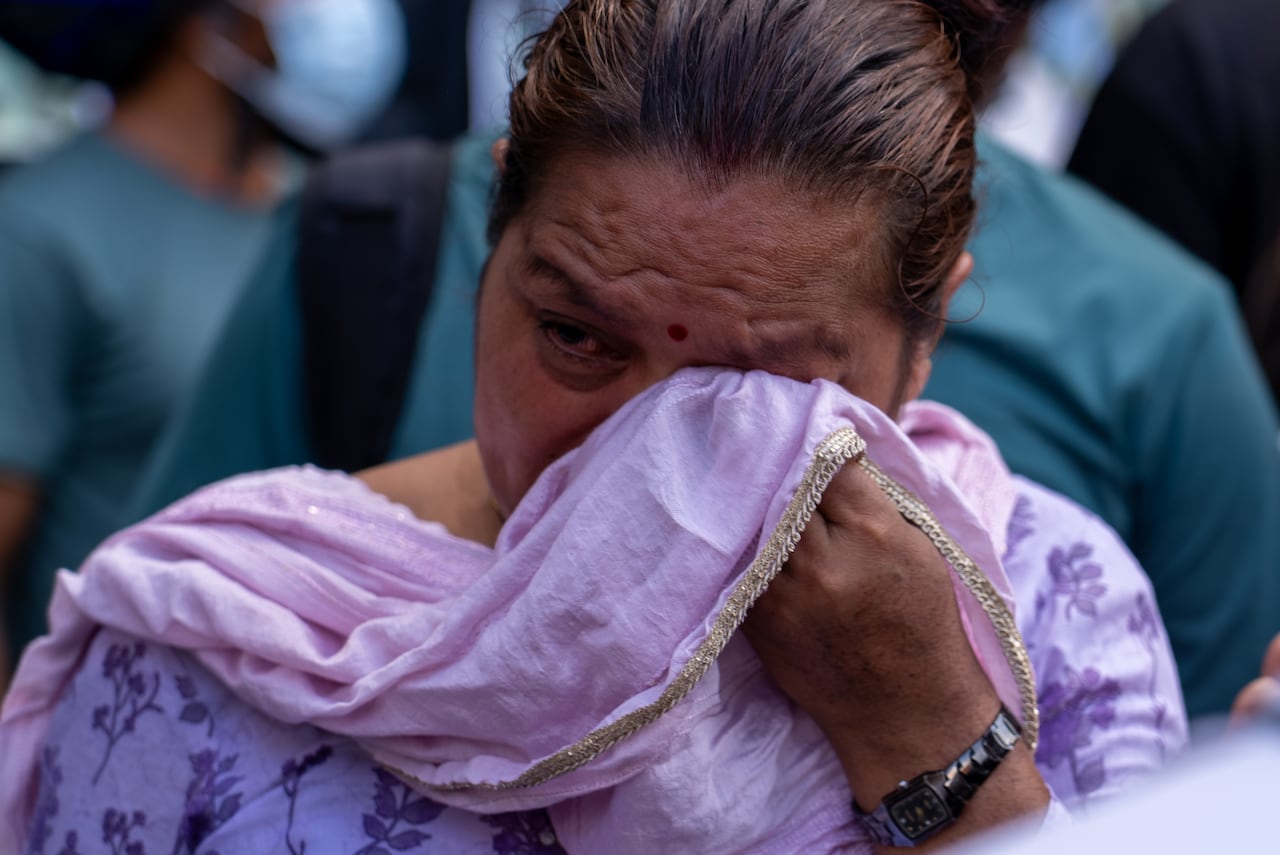
Nirmala Sapkota Koholi, 49, from Lalitpur, is seen searching for images of her younger brother among photographs displayed outside the forensic identification unit at the Tribhuvan University Teaching Hospital in Kathmandu on Friday. (Angela Johnston/CBC)
Koholi informed CBC News that her younger brother, Pradip Kumar Sapkota, was serving as a driver for a group of pilgrims that included individuals from the United States and India. He had been on a call with his daughter at 8:45 a.m. Wednesday when she heard a loud explosion, and the call abruptly ended. They have been unable to contact him since.
Koholi has visited three hospitals and suspects that one of the victim photos may be of her brother.
“He was a very good person. That is why God took him away.”

A new lake formed from debris from the glacial collapse on Wednesday has begun to overflow, according to Nepalese authorities, creating a new flood risk for downstream areas.
Red Cross raises alarm about secondary flood
Officials from the Red Cross expressed their concerns regarding a potential secondary flood during a news briefing in Switzerland, stating that their rescue operations had been temporarily suspended due to trucks carrying relief supplies being obstructed by further flooding.
“We estimate that at least 93,000 individuals have been affected and are in urgent need,” said David Fisher, the head of delegation for the International Federation of Red Cross and Red Crescent Societies in Nepal.
On Friday, Nepal’s Foreign Ministry acknowledged the offers of assistance from multiple countries with citizens missing in the disaster, but indicated that they were currently capable of managing the rescue operations themselves.
Survivors of the floods, including those injured, were transported to Kathmandu and other locations for treatment.
The regions impacted are popular destinations for hikers and pilgrimage activities.
Vishnuram Ramaswamy, an employee at a private firm in the southern Indian city of Puducherry, shared that he last communicated with his mother and two sisters, who were on a pilgrimage to Mount Kailash, on Wednesday morning at 9 a.m.
“This was their first attempt at this pilgrimage, fulfilling a lifelong wish of my mother,” he stated.
Survivor sees ‘black storm’
Among the survivors is customs officer Karbir Gaire, who was in Timure, the nearest village to the Tibet border.
Gaire had just arrived at his office around 8 a.m. on Wednesday and was engrossed in his work when he first felt the tremors.
“Immediately after the shaking, I noticed a black storm advancing toward us,” he recounted from Kathmandu, where he has reunited with his family. “We all started running out at once, and within seconds, we were climbing uphill on the other side of our office building. I believe those crucial 10 seconds saved our lives.”
The calamity was triggered by a glacier collapse that sent ice and rocks cascading downstream, registering as a magnitude-5.2 seismic event according to the U.S. Geological Survey.

An entire river valley along the Nepal border was wiped out in seconds — but local radar showed no rain, and it wasn’t an earthquake. CBC meteorologist Johanna Wagstaffe breaks down how a massive glacier collapse triggered a violent inland tsunami, and why geologists warn this unfolding climate disaster isn’t over yet.
Gaire is unsure of how many people were present in the office when the incident occurred, but he has reported that 15 of his colleagues are now missing.
“It felt like a scene from a Hollywood movie. I wouldn’t call it a flood; it was a tsunami,” he stated.
Gaire characterized Timure as a lively community brimming with government offices, hotels, cafes, banks, schools, tea shops, and residential buildings, home to over 1,500 residents.
