
A monarch butterfly from Manitoulin Island, Ontario, has gained fame locally after successfully completing an extraordinary migration across North America, culminating in Mexico this month.
Covering over 3,300 kilometers in a span of 70 days, this remarkable insect accomplished what scientists had previously deemed impossible: flying across two of the Great Lakes.
The young female butterfly, identified as MAN26021, was one of many tagged by researchers from Environment and Climate Change Canada and the Canadian Wildlife Federation on Manitoulin Island in late August.
This tagging was part of a research initiative aimed at studying the migratory behaviors and flight patterns of these butterflies.
Tags affixed to their thorax sent data using solar-powered radio transmitters.

A monarch butterfly tagged with a solar-powered radio transmitter, a tiny device weighing less than a grain of rice. (Manitoulin Nature Club)
Joe Shorthouse, a retired entomologist from Laurentian University and veteran butterfly researcher, mentioned that he and his team followed MAN26021’s journey through the Project Monarch app.
This young monarch, roughly the same weight as a paper clip, navigated across Lake Huron and Lake Michigan before making its way through the United States to the Reserva de la Biosfera Mariposa Monarca, an overwintering site located about 100 kilometers northwest of Mexico City.
Shorthouse described the achievement as a significant success story in nature.
“For the first time in history, we learned that they can fly across the Great Lakes,” he stated. “This revelation has taken everyone by surprise.”
-
What on Earth
Eddie’s dead: What one monarch’s ill-fated journey can teach us about migration patterns
-
1st of 29 monarch butterflies tagged on Canadian Prairies reaches Mexico after perilous migration
Throughout its 10-week journey, the butterfly successfully navigated various threats that typically claim the lives of most monarchs, including traffic and adverse weather conditions, as noted by Shorthouse.
Considering the additional challenge of crossing two Great Lakes, the improbability of this accomplishment becomes even more astonishing, he added.
“This is one of the most enigmatic and complicated stories in nature that remains elusive to us. How can it travel such distances, and how do they know where to go?”
The Manitoulin Nature Club, celebrating 47 years of operation on the island, expressed their pride in being the starting point for the butterfly’s extensive journey.
Phyllis Cacciotti, the club’s president, remarked that this achievement serves as a testament to the incredible strength of nature, even in its smallest creatures.
“It’s truly inspiring. These butterflies are warriors,” she expressed.
“We are fortunate here in Manitoulin Island to have such rich biodiversity, and it is essential that we protect and preserve it for future generations.”
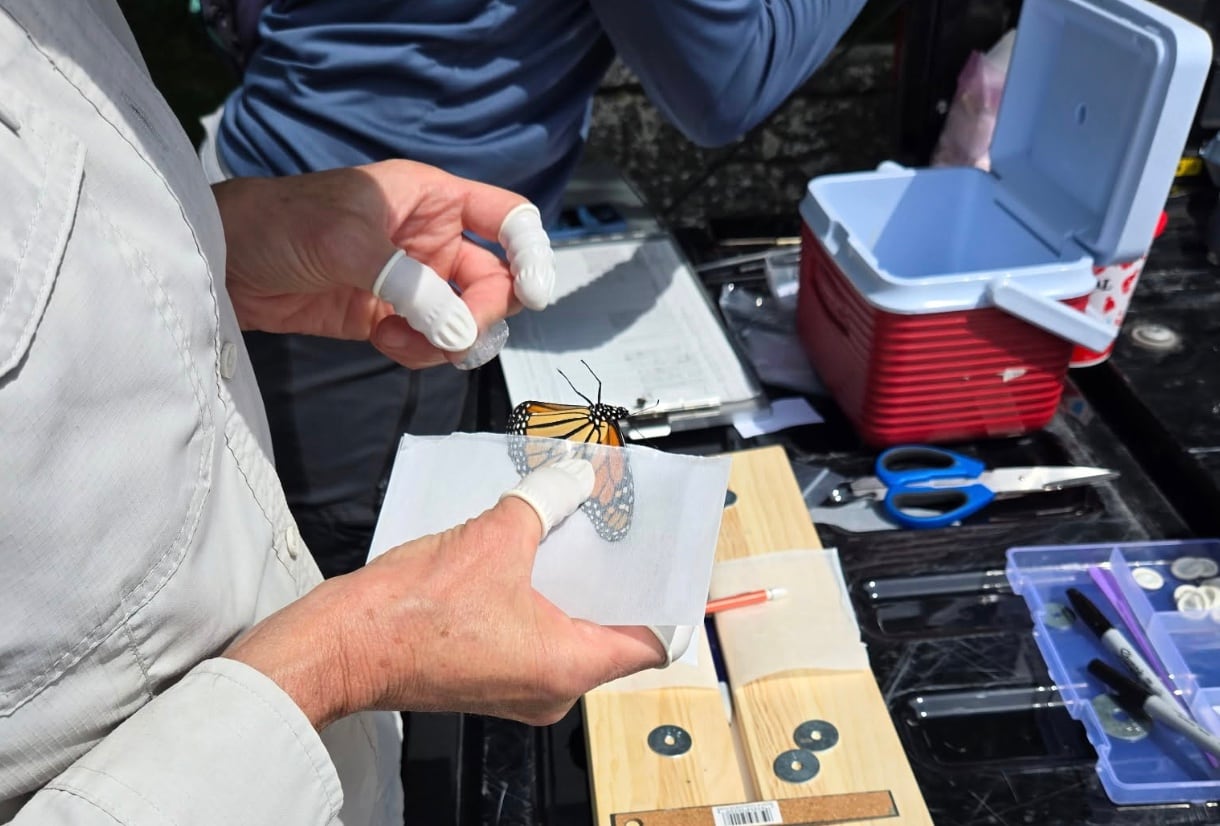
Monarch butterflies were measured and tagged on Manitoulin Island over the summer before journeying towards Mexico for the winter. (Manitoulin Nature Club)
The Manitoulin butterfly is now among thousands of its kind settling in for winter within the oyamel fir trees of Mexico’s mountains.
Shorthouse expressed hope that this remarkable butterfly will mate in the spring and travel as far north as Texas, where it would lay its eggs before passing away.
However, her legacy will endure.
The descendants of this butterfly will journey northward, possibly reaching the northern states of the U.S., and continue the same migratory cycle.
“It will be the grandchildren of MAN26021 that we will see along the shores of Manitoulin Island come May 2027.”
