Educators and parents at the forefront of the ongoing Ebola crisis in the Democratic Republic of Congo are calling on officials to postpone the reopening of schools as the number of infections continues to exceed containment efforts.
The Ebola situation, focused in the eastern Ituri province, is the most rapidly escalating in the history of the virus, with Congolese health authorities reporting 5,713 confirmed cases and 2,744 fatalities.
On Thursday, representatives from the Africa Centres for Disease Control and Prevention indicated that the weekly number of cases and deaths is still on the rise in both Ituri and the adjacent Nord Kivu province, cautioning that the actual scope of the outbreak may be considerably larger than reported figures suggest.
Kyeng Mercy, an epidemiologist and public health strategist with Africa CDC, estimated that merely 30 to 40 percent of cases are currently being identified. She noted that data from known contacts and other metrics imply significant “underdetection” within communities.
“Given all this, we are observing that this outbreak could potentially be three times larger than what is currently documented,” she stated.
‘Not at the cost of our lives’
According to the World Health Organization Regional Office for Africa, the highest case-fatality rate among all age groups in this outbreak is observed in children aged four and under, standing at 60 percent.
With schools scheduled to reopen in Congo on September 1, some parents and teachers in Ituri are advocating for a delay, arguing that the Ebola crisis still presents a significant threat to children’s safety.
“We are eager to return to classes, but not at the expense of our lives,” remarked Fazila Rebecca, a teacher in Bunia, the capital of Ituri, to The Associated Press. “As long as the virus is circulating and safety measures remain insufficient, going back to school means taking an unacceptable risk.”

Currently, there are 4,400 confirmed cases of Ebola in the Democratic Republic of Congo. Officials believe many more cases remain unrecorded. While vaccine trials are in progress, no vaccine has been finalized yet, and given Congo’s central location in Africa, concerns arise over the potential for the outbreak to spread beyond national borders.
The Ituri teachers’ union convened on Tuesday in Bunia, urging authorities to evaluate the outbreak situation before making a decision regarding school reopenings. Officials in Ituri did not respond immediately to requests for comments.
Yap Boum, who heads emergency preparedness and response at Africa CDC, mentioned that training for teachers has been expedited to ensure they understand the disease. Upon students’ arrival, their temperatures will be checked, and due to the sporadic availability of clean water, sanitizing alcoholic gel will be provided.
United Nations Secretary-General António Guterres stated on Thursday that an urgent additional $1.1 billion is required to combat the outbreak, noting that the UN’s $2.13 billion response plan is only 48 percent funded, primarily due to a significant contribution from the United States.
Guterres highlighted that international focus and resources are still behind the actual needs on the ground, warning that “without further funding, critical operations will deplete their resources just when they need to scale up.”
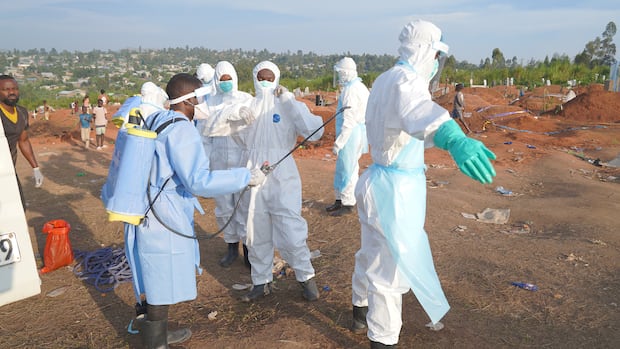
The ongoing Ebola outbreak in the Democratic Republic of Congo is officially the deadliest in the nation’s history, prompting health officials to express concerns that the situation could deteriorate further when children return to school.
The outbreak in eastern D.R.C. is advancing under exceedingly challenging circumstances, exacerbated by insecurity, displacement, a strike by health workers, and significant population movements. The World Health Organization has stated that the outbreak remains uncontrolled and is on track to exceed the 2014-2016 West Africa Ebola outbreak, which was the deadliest on record and resulted in over 11,000 deaths.
Although the current outbreak was officially declared in mid-May, officials suspect it began spreading in February. It has expanded from three health zones to nearly 60, with the majority of cases and fatalities occurring outside monitored networks and within local communities.
No approved treatments
A significant hurdle in combating the outbreak is that the unusual Bundibugyo virus responsible for it lacks approved vaccines or treatments; however, clinical trials for potential vaccines and treatments are underway in D.R.C., as well as in Canada and the U.K.
Two studies are also being conducted to assess the efficacy of the Ervebo vaccine, which was designed for the Zaire Ebola strain and earlier research has indicated may offer cross-protection against the Bundibugyo strain. In one of these trials, frontline workers have started receiving doses of the Ervebo vaccine, according to Placide Mbala Kingebeni, who manages Africa CDC’s research, clinical trials, and innovation initiatives.
Efforts to control the outbreak—ranging from limiting public gatherings to enforcing social distancing and closing airports—have disrupted life across the six affected provinces, particularly in Ituri, which has been devastated by rebel violence.
-
Ebola in the Democratic Republic of Congo: What’s going on and why is the outbreak so alarming?
-
Ebola spreading exponentially in Congo as death toll tops 2,500, UN says
The government has initiated various measures, including the installation of health and sanitation equipment in select areas, but advocacy groups assert that more action is necessary to foster trust within the community.
“Aside from the practical issues, gaining community acceptance is crucial,” stated Greg Ramm, director for Save the Children in D.R.C.
“The immediate focus must be to ensure that every school, teacher, and family possesses the information and resources required to make the beginning of the school year as safe as possible for children.”
Espérance Dz’venga was shopping for school supplies on Wednesday at the central market in Bunia. She expressed her desire for her children to attend school but voiced concerns regarding their safety.
“As a parent, I want to see my children in school, but — like many other parents — my foremost wish is for them to return home healthy,” she remarked. “We are fearful that our children could be exposed to the virus at school and then bring the illness home.”
