
On Monday, U.S. President Donald Trump announced that the FBI is looking into Nvidia CEO Jensen Huang’s relationship with a purported Chinese government agent, although he expressed confidence that the AI pioneer has no reason for concern.
During a White House briefing, Trump stated, “I know the FBI is investigating this matter in relation to something else, and I believe he will be fine.”
The unexpected revelation of Huang’s affair has sent shockwaves through both the political realm and the technology sector in the United States, raising alarms about China’s potential access to advanced chips produced by Nvidia that are crucial for AI development.
Trump hinted at the unusual notion of personally engaging in a counterintelligence probe, reflecting his cordial rapport with Huang and the possible international implications.
“I spoke with him today just to check on how he was doing,” Trump remarked. “He indicated that he had no knowledge that the individual in question was a spy.”
Huang, a prominent figure in the tech industry and among the wealthiest individuals globally, has admitted to the affair, offering an apology to both his wife and Nvidia in an open letter on the company’s website. According to the New York Times, U.S. intelligence has confirmed that the woman was allegedly gathering intelligence for Beijing.
In his letter, Huang stated, “I fully support the investigation and will cooperate completely. I love our country and our company. I am dedicated to safeguarding NVIDIA and reinforcing America’s national security.”

Nvidia CEO Jensen Huang speaks at an event in London, on Oct. 14. (Kwiyeon Ha/The Associated Press)
Nvidia announced on Sunday that it is launching an independent inquiry regarding claims that Huang was the “target of a foreign intelligence operation.”
This situation is also drawing attention from Congress, with leading Democrats like Sen. Mark Warner and Rep. Hakeem Jeffries expressing their intent to delve deeper into the matter. Jeffries mentioned that the Nvidia issue was discussed during a private meeting with the CIA director and the director of national intelligence, which primarily focused on Iran.
“We will require a comprehensive briefing specifically regarding the Nvidia situation to understand what has transpired,” he noted, “and what the implications are for America’s national security.”
No plan to confront Xi
Next week, Trump is scheduled to meet with Chinese President Xi Jinping in Shenzhen, China, during the Asia-Pacific Economic Cooperation summit, but he remained uncertain about addressing the issue with Xi.
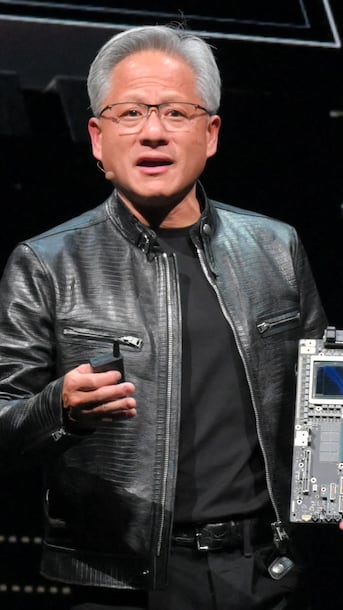
U.S. tech giant Nvidia’s shares tumbled after CEO Jensen Huang admitted to an affair with a woman accused of spying for Beijing. Andrew Chang breaks down what we know so far and what the scandal means for the world’s most valuable AI chipmaker.
“No, I don’t think so,” Trump replied when asked about discussing the matter with Xi. “Maybe. I’m sure President Xi will inquire about it. I just know Jensen very well, and I believe he is a very honorable man.”
The FBI’s counterintelligence operations frequently investigate foreign nations’ attempts to spy on the U.S., whether through covertly acquiring technology from American companies, conducting foreign influence campaigns to sway public perception, or nurturing connections with influential political and industry leaders.
Such probes can extend for years and may not always result in criminal charges. Throughout various presidential administrations, China has consistently been viewed as a persistent counterintelligence risk.
On Monday, China refuted allegations of attempting to entrap Huang. “The so-called Chinese spy claim is baseless. It is merely an attack against China,” stated Guo Jiakun, spokesperson for the Ministry of Foreign Affairs.
Previously, Beijing dismissed a New York Times report alleging that Huang had formed a close connection with a Chinese national named Alice Huang, who operated a firm accused last year of illegally shipping advanced Nvidia chips to China.
The Times reported that she was a former executive of a Singapore-based data center company called Megaspeed International, which prominently advertises its partnership with Nvidia on its website, and that U.S. intelligence has concluded she was collecting information for Beijing.
Many offices in Singapore were closed on Monday for a holiday, and neither Megaspeed nor the Singapore Ministry of Home Affairs immediately responded to requests for comments.
Nvidia ranks among the world’s most valuable publicly traded firms, alongside giants like Apple and Microsoft. Its chip sales to China have sometimes been targeted by U.S. regulators aiming to restrict Beijing’s access to advanced technology.
The Nvidia logo is displayed at the Computex Taipei expo in Taipei, Taiwan, on June 3. (Chiang Ying-ying/The Associated Press)
George Chen, a partner and head of digital practice at The Asia Group, a consultancy based in Washington, commented, “The primary concerns are whether he was aware of any espionage activities and if any sensitive or confidential information was compromised.”
He added, “These issues require evidence rather than mere speculation,” in a message to reporters.
Chinese media has mainly focused on Huang’s admission of the affair, with state media echoing official government statements. Some have suggested that the New York Times report aims to destabilize U.S.-China relations.
The state-owned Global Times remarked, “Whenever relations between China and the U.S. begin to improve, there are often individuals firing shots from the shadows.”
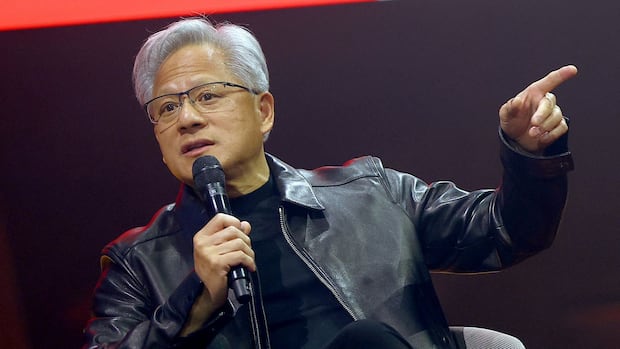
Nvidia is opening an investigation into its CEO, Jensen Huang, after he admitted to having an affair. The woman in question is accused of being a Chinese spy, having allegedly passed information to Beijing, according to a media report. New York Times reporter Julian E. Barnes, who broke the news of Huang’s relationship, says ‘there is a long way to go on this story.’
