What is the essence of dark energy? Is there a multiverse? Are there additional forces beyond the four fundamental forces we currently acknowledge?
These represent only a fraction of the numerous unresolved questions in physics, yet these enigmas — along with the curiosity they generate — serve as inspiration for particle physicist Asimina Arvanitaki.
Throughout her scientific journey, Arvanitaki has explored topics ranging from subatomic particles to the vastness of the universe — traveling from her homeland of Greece to the Perimeter Institute for Theoretical Physics in Waterloo, Ontario, where she is currently employed. During an event at the Perimeter Institute on October 7, Arvanitaki shared insights with Ideas host Nahlah Ayed about her scientific path, the essence of science, the impact of artificial intelligence, and more. Below is an excerpt from their discussion.
Can you discuss how curiosity has influenced your love for science and your research?
You can’t become a scientist if you aren’t comfortable with being confused regularly.
I grew up in Greece, and by the end of high school, you are obligated to select a major — which is a daunting process because often you have no idea what you want for your future. In my situation, I was torn between science and engineering. I enjoyed math, physics, and chemistry — all of it. I discovered that I was more intrigued by the “why” of things rather than just figuring out how they function.
This realization led me to pursue physics. Ultimately, I chose to specialize in particle physics because it addresses the fundamental components of matter. Although it concerns incredibly small entities, understanding the entire cosmos is essential to grasp how everything interconnects. Thus, it’s a vast field that grants me considerable intellectual freedom.
Can you share the first instance of scientific curiosity you remember as a young girl?
In elementary school, I learned about the distance from the sun and discovered that the speed of light is finite. I calculated that sunlight takes eight minutes to reach us, and I thought, “Oh my goodness! We’ll never perceive the sun as it currently is!” … It could explode! We have eight minutes to escape!
What does curiosity look like during scientific work?
We engage in it so instinctively. Every question we ask embodies curiosity. For me, it’s present in everything. It’s like wondering, how does this microphone function? There are infinite inquiries. It might involve asking why we have wood paneling on the walls. Is it for sound quality? Is it for aesthetics? Curiosity can pertain to anything.
It appears that currently, a significant amount of science funding is directed towards finding or developing solutions with immediate, practical applications. What risks arise from placing too much emphasis on that, as opposed to research driven by curiosity?
Let’s rewind to the 19th century. At that time, Rockefeller was the wealthiest individual globally. Imagine he had a vision issue and sought eye surgery. He approached his doctor and said, “Doctor, I don’t want to wear glasses. Can you discover a minimally invasive technique that doesn’t involve inserting anything into my eye that could cure me?” This implies he was looking for laser surgery.
With all his wealth, he would need to uncover quantum mechanics, understand how light emits from atoms, grasp Einstein’s theory of stimulated emission, and then wait for another 40 years for the first laser to emerge before seeking out its applications.
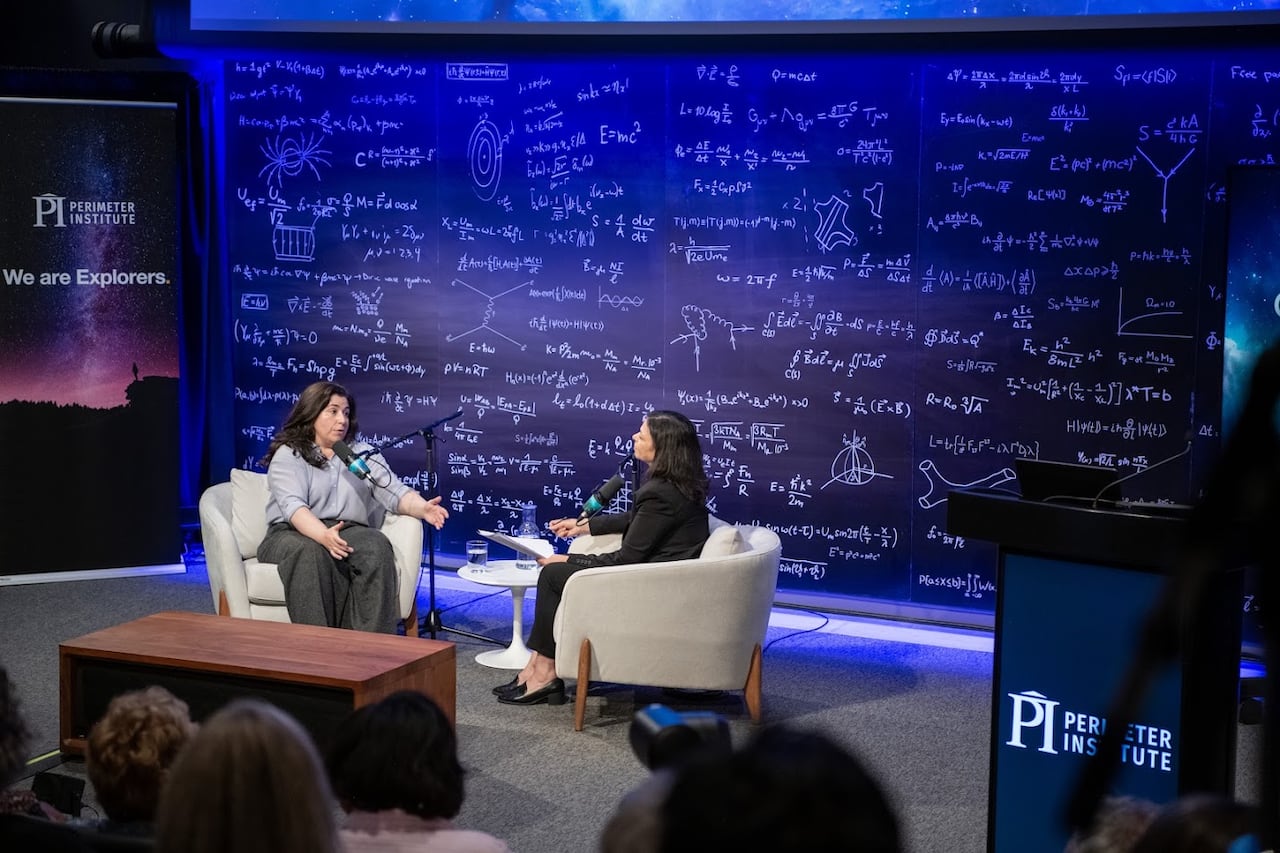
Arvanitaki, left, conversing with Ideas host Nahlah Ayed about her journey as a physicist, the significance of curiosity-driven research, and the influence of AI in science. (Gabriela Secara/Perimeter Institute)
When you start focusing on the application — the ultimate goal — you miss out on discovering transformative technologies. Therefore, no amount of money can procure the genuinely revolutionary advancements, as they stem from profound understanding. Achieving that understanding often necessitates navigating through uncertainty.
I’m curious if there’s a risk [with AI] that we might lose our ability to gain insights, experience awe, and maintain a sense of wonder and curiosity with such an advanced tool at our disposal.
I don’t believe so.
Let’s reflect on ancient times. One of my ancestors, Socrates [laughs] — he claimed that writing was the worst thing to ever happen to humanity. It damages the brain. He believed that people should avoid writing because it leads to forgetfulness and hinders brain training.
-
Chemist who transformed energy storage nabs Canada’s top science prize
-
Canadian astronaut Joshua Kutryk conducts his 1st spacewalk
However, if you consider it, writing and language have been our most powerful tools for ensuring the intergenerational transfer of knowledge. They have allowed us to build upon the achievements of our ancestors. This perspective shapes my view.
We are currently undergoing a technological revolution that will alter our methods. We will adapt to these changes. I genuinely believe, for instance, that it will redefine what we consider important. AI excels at performing calculations, which means we will no longer spend time on them, something I personally dislike. Yet, the value of ideas remains significant.
Tag: rewrite-pending
